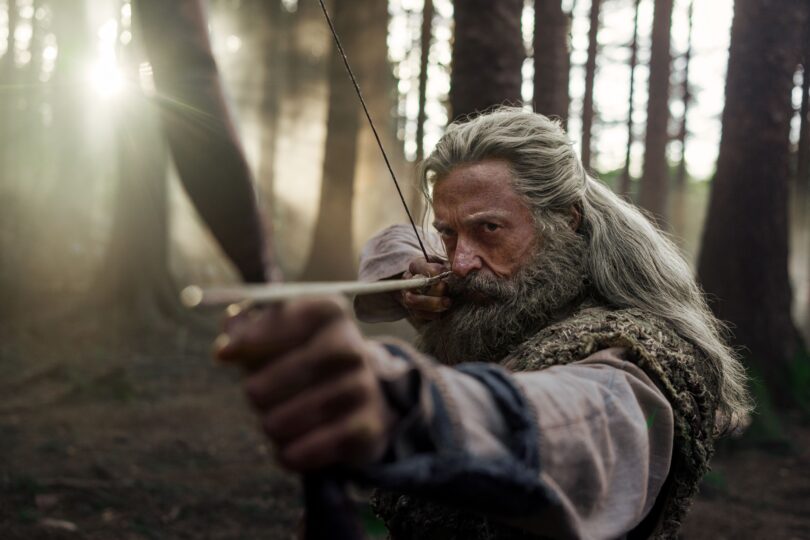

There’s no derring-do in “The Death of Robin Hood” (R, 122 minutes, in theaters).
No Errol Flynn charm.
No heroics.
No tights.
In this revisionist take on Robin Hood, writer-director Michael Sarnoski (“Pig”) combines crude, primal violence with meditations on the making of legends through storytelling, on the futility of seeking vengeance, on the weight of sin, on finding redemption through service to others. Sarnoski’s film essentially is about finding grace in a world ruled by brutality.
The film opens in 1247. Robin Hood (Hugh Jackman), now an old man worn down by his life of violence, exists alone in a rocky, desolate area of Northern England. There he awaits his countless victims’ kin, all on their separate missions to kill him. That they’ve all failed is evident from a collection of stone burial plots nearby.
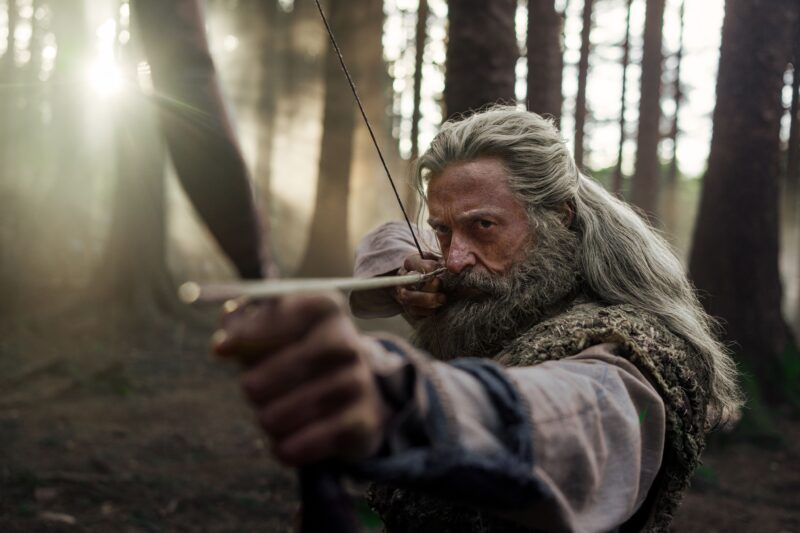
Hugh Jackman stars in “The Death of Robin Hood.” (A24)
This is not the Robin of lore. Robin scoffs at the stories that have made him a hero. Steal from the rich to give to the poor? Lies. Robin has always been an outlaw, a ruthless thief capable of great cruelty. Even now, in his advanced age, he doesn’t seem to feel any remorse. He’s just … tired.
Little John (Bill Skarsgard), his best friend and former right-hand man, arrives seeking help. He tells Robin about how he murdered a man and has taken his name, wife and farm to start a new life. The family that owns the land, however, has taken the farm — along with the wife — back, and Little John wants to retaliate and regain what he believes is now his. He persuades reluctant Robin to join him on this quest.
A battle ensues, with opponents getting, to paraphrase Quentin Tarantino, medieval on each other. Badly wounded, Robin is taken to a monastery run by Sister Brigid (Jodie Comer), known for her powers of healing. There, as he recuperates, Robin keeps his identity a secret, calling himself Randolph.
Will he experience a rebirth and new life? He meets a dying leper (Murray Bartlett), the priory’s caretaker, who is devoted to Brigid and encourages Robin to take over for him. He becomes a protector of sorts of a young orphan girl. He is drawn to Brigid, a person of great depth and kindness.
But his past continues to hover over him, and a reckoning seems inevitable.
Those eagerly anticipating some action-packed, cathartic climax, however, should prepare to be disappointed. To its great credit, Sarnoski’s film plays out in a more cerebral, more subtle way, and is more challenging, and rewarding, as a result.
The most powerful scenes are also the most quiet, whether it’s Brigid talking to Robin about finding balance in life; the leper revealing secrets to Robin with an implied forgiveness; or Robin, Brigid and the orphan girl sharing a meal without saying a word. These are moments of great beauty.
The acting is exceptional.
Jackman continues to challenge himself with diverse leading roles — Is this really the same actor who played the Neil Diamond interpreter in “Song Sung Blue”? — and here is able to walk the fine line of revealing glimpses of genuine emotion while maintaining the coldness it takes to kill and survive.
As the leper, Bartlett (“The White Lotus”), despite being wrapped from head to toe in bandages most of the time, conveys moral strength combined with sensitivity and vulnerability born from great personal suffering.
And Comer (“The Bikeriders,” “Killing Eve”), who with one look can reveal an explosion of deep thoughts and feelings, continues to make a case for herself as the most compelling performer working in film today.
The cinematography, production design and, especially, Jim Ghedi’s haunting folk/string music, create an appropriately rich atmosphere for this grim but profound drama. **** (out of four)
** Click here for Tim Miller’s previous movie columns for Cape Cod Wave **
Please like Cape Cod Wave on Facebook.
Cape Cod Wave Magazine covers the character & culture of Cape Cod. Please see our Longform stories.
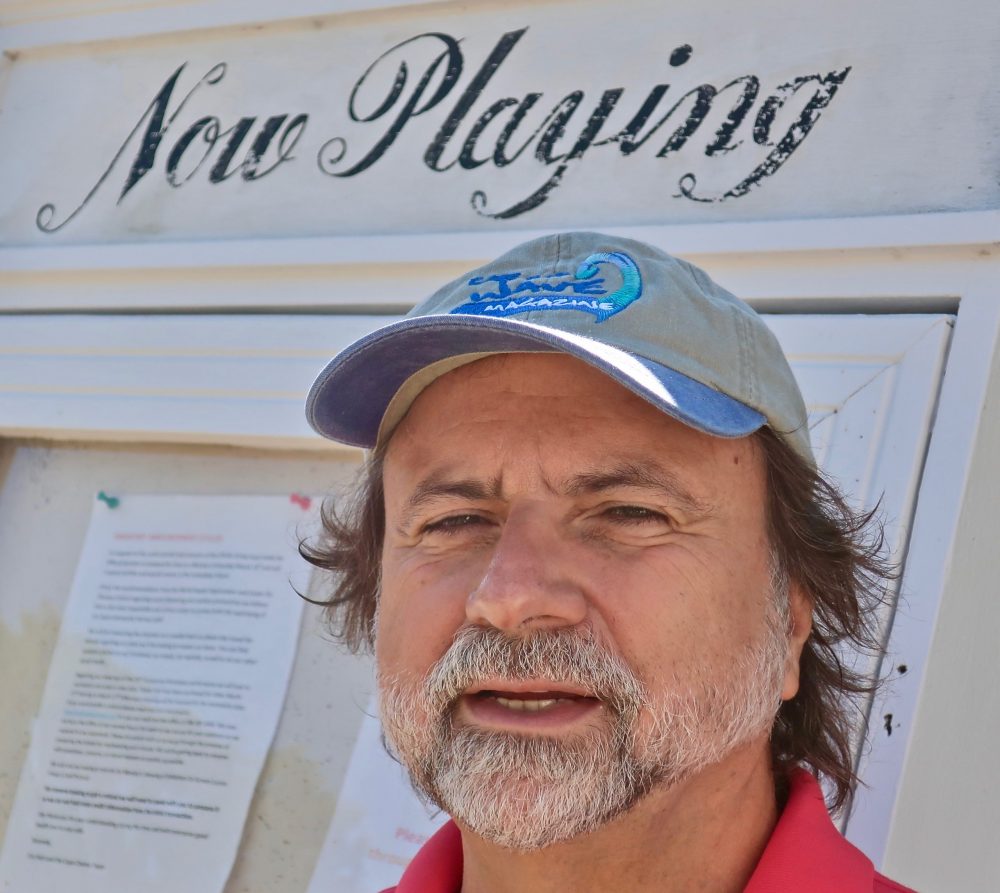
Tim Miller, Movie Critic
Tim Miller is co-president of the Boston Society of Film Critics and a Tomatometer-approved critic. He teaches film and journalism at Cape Cod Community College in West Barnstable. You can contact Tim at [email protected]. Or you can ignore him completely.