

The ironically titled “You Can See Everything” (R, 174 minutes, in theaters) could have been called “WTF.”
It makes your head want to explode — in a good way.
It’s a documentary, but, even then, it makes you question whether it really is a documentary. It makes you question EVERYTHING. Is this movie a put-on? Are its subjects putting us on? Are the filmmakers putting us on?
What the hell is going on here?
The film — on the surface, at least — is about Elizabeth Holmes, who was convicted of defrauding investors through false claims involving a blood-testing device created by her heath-technology company, Theranos.
But to say “You Can See Everything” is about Holmes is like saying Dostoevsky’s “Crime and Punishment” is about a murder. It’s just the starting point.

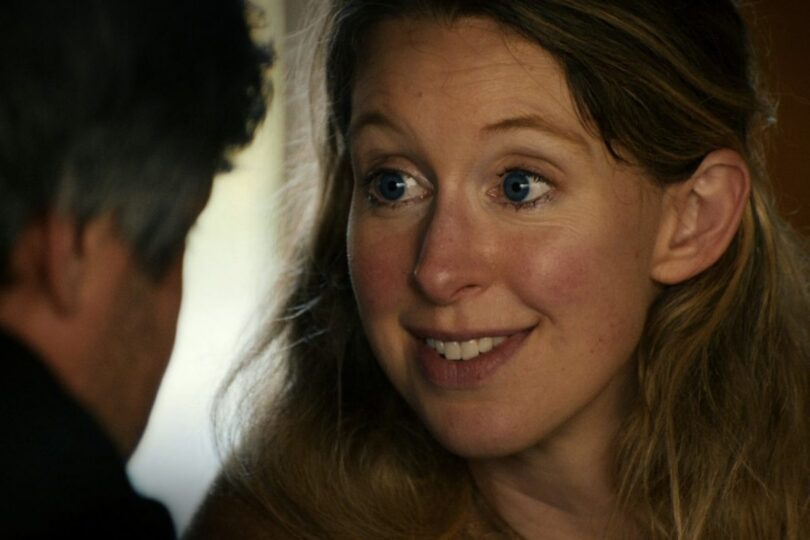
Nathan Fielder interviews Elizabeth Holmes. (A24)
The film was co-directed by deadpan comic Nathan Fielder (“The Rehearsal”) and Lance Oppenheim (“Primetime”). While Oppenheim stays mostly off-screen (except for a short stint as himself in a re-creation), Fielder is the primary onscreen presence in the film.
As with the documentaries of Nick Broomfield (“Aileen: Life and Death of a Serial Killer,” “Kurt & Courtney”), Fielder and his investigation is as much a part of the movie as his subject.
The film starts in 2023, 34 days before Holmes is to enter prison to serve more than 11 years in prison. Holmes and her life and business partner, Billy Evans, have allowed Fielder and his crew supposedly complete access to their lives for the remaining part of Holmes’ freedom.
From the start, Fielder is skeptical and confused. Why have they chosen him? Are they trying to use him in some way?
Holmes says right off the bat that she didn’t do anything wrong. She’s innocent. She not only didn’t lie to investors, she’s never lied in her life.
When Fielder tries to pin her down on this — Why was she found guilty then? What went wrong? She’s never lied in her entire life? — it becomes a game of semantics. Apparently, people misunderstood her. And she’s apparently incapable of understanding why they misunderstood her.
Fielder, as he does through most of the film, stares at her, dumbfounded.
Evans, meanwhile, appears to interpret things, but his explanations are so slippery and confusing that he only adds to Fielder’s bafflement.
Desperate, in a scene that surely is an instant classic, Fielder shows the couple Abbott and Costello’s classic “Who’s on First?” bit, which Holmes and Evans claim they’ve never seen. Holmes appears not to understand what’s behind the humor, or how it relates to her communication issues. Evans claims that Holmes’ inability to understand reflects what makes her different, what makes her special.
Field stares at them. What planet is he on?
And so it goes, for almost three hours. It gets stranger and stranger, with layers piling on each other to the point where nothing can be taken for granted.
It’s laugh-out-loud funny and tragic and weird and challenging and strangely moving. It even features an Oscar-worthy performance, but I can’t say by whom or why without giving away too much.
Trust me on this one: Just see it. **** (out of four)

Tim Miller
Tim Miller is co-president of the Boston Society of Film Critics and a Tomatometer-approved critic. He teaches film and journalism at Cape Cod Community College in West Barnstable. You can contact Tim at [email protected]. Or you can ignore him completely.